
Lone Worker Compliance (LWP): Obligations, Risks and Solutions to Protect Your Lone Workers

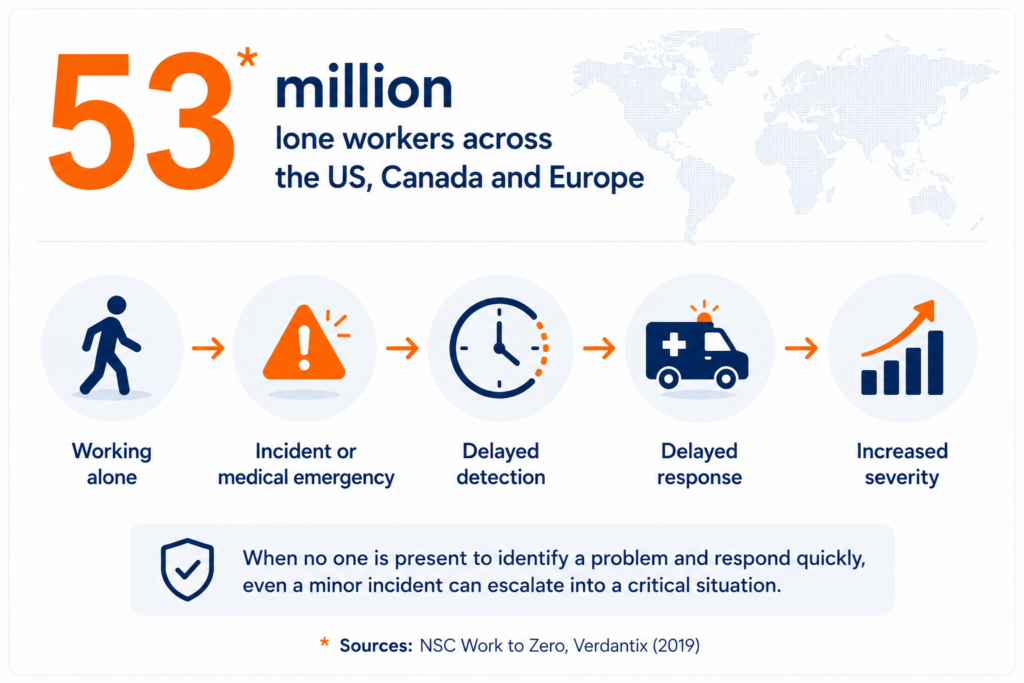
53 million+ lone workers operate across the US, Canada, and Europe, a figure that continues to grow. In 2023 alone, the EU recorded 2.83 million non-fatal workplace accidents, with the majority occurring without witnesses present.

For executives and operations directors, this represents lost productivity, direct financial costs, and significant legal risk.

Without proper lone worker protection measures, a minor incident can quickly escalate when help isn’t immediately available.

Summary

What Defines a lone worker?

A lone worker is anyone working without direct supervision or immediate colleague support, facing increased risk during incidents or emergencies.

Across international health and safety frameworks, isolation isn’t inherently dangerous, but a significant aggravating factor that can increase the severity of an incident. Data shows that workplace incidents often lead to serious consequences:

When workers operate alone, delayed response times significantly increase the severity of incidents.

lone worker risk statistics in the EU: 76% of workplace accidents cause injuries and 24% of fatal accidents occur in construction, highlighting increased risk when employees work alone

This applies to many types of activities, particularly those involving physical risk, hazardous environments, or specific safety requirements such as electrical work, working at height, or remote field operations.

Lone Worker Safety: What are the employer’s legal responsibilities?

Across Europe and internationally, employers have a duty of care to ensure the safety and health of their employees.

In the EU, this obligation is defined under Directive 89/391/EEC, which establishes that employers must take all necessary measures to protect workers in every aspect of their job.

In practical terms, when risk assessments identify hazards related to lone working, organizations must implement:

  • Organizational measures (reducing or supervising lone work where possible)
  • Appropriate safety and alert systems (such as LWP/DATI solutions)
  • Emergency procedures that are tested, documented, and operational

These principles are reflected in most international safety frameworks, including OSHA requirements in the United States and national risk assessment frameworks such as France’s DUERP (Document Unique d’Évaluation des Risques Professionnels).

What are the risks and costs of LWP non-compliance?

Failing to protect lone workers extends beyond regulatory compliance . It exposes organizations to major financial, operational, and workforce-related risks:

  • Direct costs of accidents: Severe workplace incidents can cost companies hundreds of thousands of euros or more, depending on severity and sector
  • Indirect costs: Disruption, administrative burden, workforce replacement, and decreased morale
  • Operational impact: In many European countries, employees have the right to stop working if they face serious and imminent danger, potentially halting operations.
  • Reputational damage: In the event of an incident, failure to protect lone workers can lead to media exposure, loss of employee trust, and difficulty attracting talent.

Beyond compliance, this is a core business risk.

Why traditional Lone Worker Devices are no longer enough?

For years, standalone lone worker alarm devices were the standard. Today, they struggle to meet the demands of modern work environments:

  1. Low adoption: Often seen as inconvenient, they are frequently forgotten or not used
  2. Limited situational awareness: Without real-time location or audio verification, responders operate with limited visibility.
  3. No incident management: Alerts are not enough without real-time coordination and follow-up

As work environments become more complex and mobile, these limitations become critical.

How to ensure effective protection in the field?

Effective lone worker protection requires both technology and operational readiness, from detection to intervention:

  1. Alert triggering and prioritization: Combine manual alerts (SOS) with automatic detection (fall detection, prolonged immobility), with immediate escalation and prioritization.
  2. Accurate real-time location: Quickly locate the person in distress, indoors and outdoors, to guide responders effectively.
  3. Verification and coordination: Establish voice communication to assess the situation and mobilize appropriate resources without delay.

To meet these requirements without multiplying devices, STREAMWIDE’s Team on the Run solution combines alerting, location, and coordination into a single platform. The professional smartphone becomes a unified safety tool for lone workers.

In practice, beyond triggering alerts, Team on the Run (TOTR) enables full real-time incident management:

  • Monitor alerts via a dedicated interface for immediate response
  • Assess the situation to determine severity and adapt the response
  • Coordinate intervention by mobilizing the most relevant resources (internal teams or emergency services)
  • Ensure tracking and traceability through to resolution, with a complete action history

Conclusion: Safety as a driver of operational performance

Investing in a modern LWP solution like Team on the Run (TOM) goes beyond regulatory compliance. It sends a strong message to field teams: their safety matters every day.

By improving response times and streamlining equipment, organizations strengthen worker protection while ensuring business continuity and operational performance.

Would you like to enhance the protection of your team members?

Our experts will help you assess your needs and implement a protection solution tailored to your operational requirements.

FAQ | Lone Worker Protection (LWP / DATI)

Q1: What is a LWP device?

A LWP (Lone Worker Protection) device, also known as DATI (Lone Worker Alarm Device), is equipment (dedicated device or smartphone app) designed to detect distress situations, manually or automatically and send a geolocated alert to a supervisor or monitoring center.

Q2: Is LWP mandatory?

There is no single global regulation mandating LWP devices specifically. However, in most regions:

  • In the EU, Directive 89/391/EEC requires employers to ensure worker safety
  • In the US, OSHA enforces a general duty to provide a safe workplace
  • In many countries, risk assessments must identify and mitigate lone worker hazards

In practice, LWP/DATI solutions are widely used to meet these obligations.

Q3: Which industries are most exposed to lone worker risks?

Several sectors are particularly exposed, including:

  • Construction
  • Industrial maintenance
  • Logistics and transportation
  • Healthcare and home services
  • Energy and utilities
  • Private security

Beyond these sectors, any activity involving isolated work or irregular hours (cleaning, on-call duties, night shifts, remote interventions) may also be concerned.

Still have questions ?

Logo SW
Privacy Overview

STREAMWIDE, as Data controller, undertakes to comply with the protection of your personal data in accordance with the European Regulation 2016/679 of 27 April 2016 and the French law n° 78-17 of 6 January 1978 as amended.

This Privacy Policy details in a transparent manner how STREAMWIDE collects and uses your personal data when you visit the website accessible at https://www.streamwide.com/ (the "Site") and/or when you wish to obtain services or information offered on the Site (the "Services").

By using the Site, you agree to the Privacy Policy.

For more information, click here