

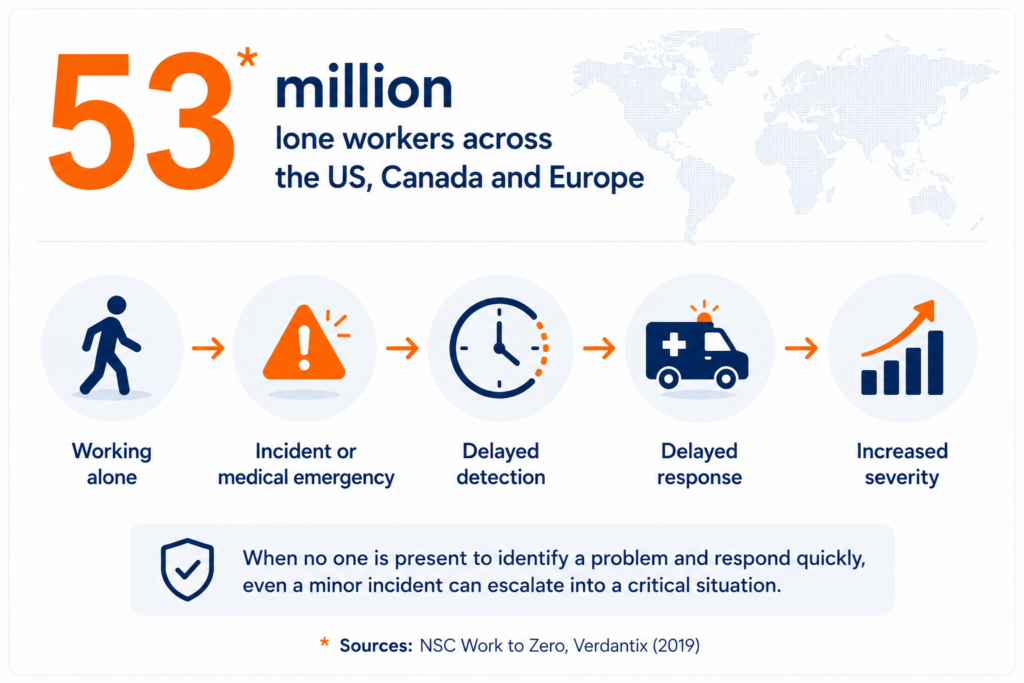
An estimated 53 million people work alone across the United States, Canada and Europe. This figure continues to grow as organizations rely on increasingly mobile, distributed and autonomous workforces.
But beyond the numbers, one question remains: what happens when an incident occurs and no one is there to raise the alarm?
If one of your employees suffers a medical emergency while working alone, is your organization able to detect the situation quickly and ensure an effective response?
A lone worker is anyone carrying out their duties without direct supervision or immediate assistance from colleagues in the event of an incident or emergency.
Working alone is not a hazard in itself. However, it can significantly increase the consequences of an incident by delaying its detection and the arrival of assistance. A situation that might be quickly resolved in a team environment can become far more serious when no one is present to identify the problem and respond quickly.
Lone working can affect a wide range of roles and industries, including maintenance technicians, security personnel, healthcare professionals, field service workers, utility crews and employees working remotely or during off-hours.
Across Europe and internationally, employers have a duty of care to ensure the safety and health of their employees.
In the EU, this obligation is defined under Directive 89/391/EEC, which establishes that employers must take all necessary measures to protect workers in every aspect of their job.
In practical terms, when risk assessments identify hazards related to lone working, organizations must implement:
These principles are reflected in most international safety frameworks, including OSHA requirements in the United States and national risk assessment frameworks such as France’s DUERP (Document Unique d’Évaluation des Risques Professionnels).
Failing to protect lone workers extends beyond regulatory compliance. It exposes organizations to major financial, operational, and workforce-related risks:
Beyond compliance, this is a core business risk.
For years, standalone lone worker alarm devices were the standard. Today, they struggle to meet the demands of modern work environments:
Effective lone worker protection requires both technology and operational readiness, from detection to intervention:
To meet these requirements without multiplying devices, STREAMWIDE’s Team on the run solution combines alerting, location, and coordination into a single platform. The professional smartphone becomes a unified safety tool for lone workers.
In practice, beyond triggering alerts, Team on the run (TOTR) enables full real-time incident management:
Investing in a modern LWP solution like Team on the run (TOTR) goes beyond regulatory compliance. It sends a strong message to field teams: their safety matters every day.
By improving response times and streamlining equipment, organizations strengthen worker protection while ensuring business continuity and operational performance.
Our experts will help you assess your needs and implement a protection solution tailored to your operational requirements.
A LWP (Lone Worker Protection) device, also known as DATI (Lone Worker Alarm Device), is equipment (dedicated device or smartphone app) designed to detect distress situations, manually or automatically and send a geolocated alert to a supervisor or monitoring center.
There is no single global regulation mandating LWP devices specifically. However, in most regions:
In practice, LWP/DATI solutions are widely used to meet these obligations.
Several sectors are particularly exposed, including:
Beyond these sectors, any activity involving isolated work or irregular hours (cleaning, on-call duties, night shifts, remote interventions) may also be affected.
